|
On This Date (October 17) in 1963, The Beatles recorded 'I Want To Hold Your Hand'. Ringo's drumming on the track is particularly adroit, as I detail in my BEATLES MINUTE on the topic: I debut a new program tomorrow - the first debut since 1 September 2016, when I premiered Come Together: Structure in Beatles Music at Butler University.
Tuesday, 18 October 2016, 7:00-8:00 p.m. Newton Free Library, 330 Homer St, Newton, MA Two Sides of the Same Coin: The Lennon/McCartney Dynamic Few songwriting teams are as well respected as John Lennon and Paul McCartney. This 60-minute multimedia presentation will compare and contrast their songwriting over the course of The Beatles' career.
0 Comments
Choruses are defined by three primary elements: 1) repeated lyrics, 2) high energy, and 3) thick texture. These three factors all contrast verses, which typically use different lyrics with each iteration, are comparatively less energetic, and usually feature a thinner texture. Take 'Yellow Submarine', for example. 1) repeated lyrics Each of the four verses of 'Submarine' implement the same music but different lyrics. Verse 1: "In the town where I was born..." Verse 2: "So we sailed unto the sun..." Verse 3: "And our friends are all aboard...." Verse 4: "As we live a life of ease..." But the choruses feature both the same music and the same lyrics: Choruses 1, 2, and 3: "We all live in a yellow submarine...." 2) high energy The choruses, in comparison to the verses, elevate the energy levels. That's not to say that verses are - or have to be - low in energy, but typically they are lower in energy. And that distinction is easily discernible listening to 'Yellow Submarine'. 3) thicker texture Ringo sings the verses by himself, but he's joined by many more voices in each of the choruses. This helps provide the "thicker texture" characteristic of choruses. Those three factors are the primary distinguishing factors when interpreting any given section as a chorus. Of course, there is some ambiguity when it comes to distinguishing choruses from refrains, which also employ the same lyrics on each iteration. But refrains are dependent on the verse, whereas choruses are independent of the verse. In other words, you can't have a refrain all by itself but it's common to find a chorus all by its lonesome For more consideration on the sometimes difficult decision, see my blog Ambiguity in 'The Fool on the Hill'. With those factors in mind, 66 (31.3%) of The Beatles' 211 tracks use at least one chorus. And those 66 songs use their choruses in a number of different ways. 4 (6.1%) of those 66 are based on the verse, meaning the verse and chorus are strongly related (same pacing, same harmonies) even though the choruses are clearly distinct from the verses.
14 (21.2%) of Beatles choruses are "faulty bridges" (John Covach's words, not mine) in deceptive AABA forms. The Beatles looooved AABA form, using it in 57% of their songs. For those not already familiar with AABA structure, the BEATLES MINUTE video below explains it, using 'Please Please Me' as an example. But AABA designs require a bridge. And several songs, though literally AABAs, don't function as such because the B section is a chorus instead of a bridge. These are called "deceptive AABA" structures.
A song's structure typically begins with the first verse. Anything prior to that first verse can be thought of as introductory. Choruses, being high-energy and catchy by nature, often make ideal introductions because they quickly hook a listener's attention. 19 (27.8%) Beatles songs use an introductory chorus:
Similarly, though more ambiguously, choruses can also be used at the ends of songs. Concluding choruses are iterations of the chorus, but are somehow altered to propel the song to its conclusion. This is often a repetition of the final phrase (such as "And with a love that like, you know you should be glad" in 'She Loves You'), or a fade out (example: 'I'm Down'), or occasionally a combination of the two (see 'Little Child'). 33 (50.0%) of songs use a concluding chorus:
Almost all (52 - 78.8%) Beatles songs to use choruses use them as part of a compound module, meaning that the chorus combines with another section (almost always a verse) to create a module that is then repeated (sometimes partially, though usually in full) throughout the song.
Lastly, 6 (9.1%) Beatles songs use the chorus in unique ways, and will therefore be considered individually.
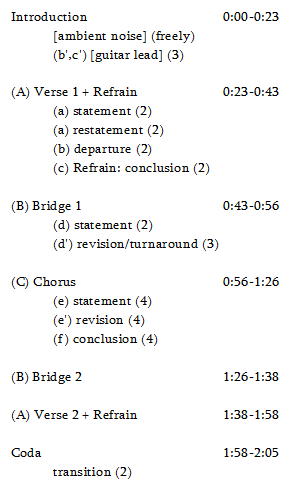
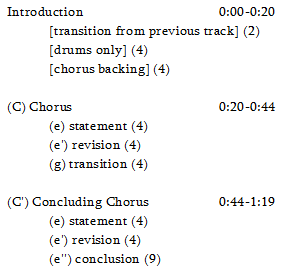
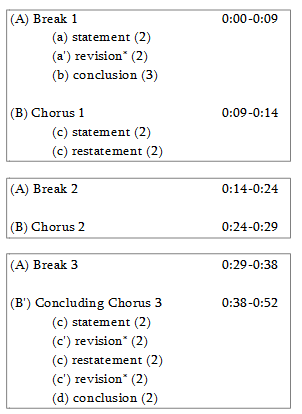
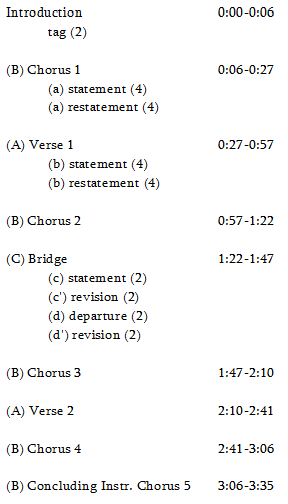 It is tempting to call the first chorus an "introductory chorus" because it precedes the first verse. But, highly unusual, in this case the structure begins with the that first chorus and not with the first verse. The fifth and final chorus, on the other hand, is clearly a concluding chorus.
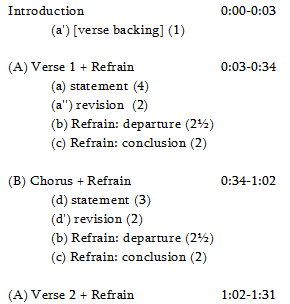 'Slumbers' is also the only Beatles song to use a "chorus + refrain". A refrain typically cannot appear in a chorus because there's no way to discern the "chorus proper" from the refrain. In 'Golden Slumbers', however, the reprise of the refrain found in the verses makes that distinction. Careful readers might notice that, unlike other Formal Level sections, choruses are typically used in more ways than one within a single song. In fact, only 15 (22.7%) of the 66 tracks listed above use the chorus in one way only:
The remaining 51 (77.3%) use choruses in multiple ways. For example, the four choruses of 'Can't Buy Me Love' are used in four different ways: the first is an introductory chorus, the second is a "faulty bridge" as part of a deceptive AABA, the fourth is a concluding chorus, and the second through fourth are all part of compound modules. 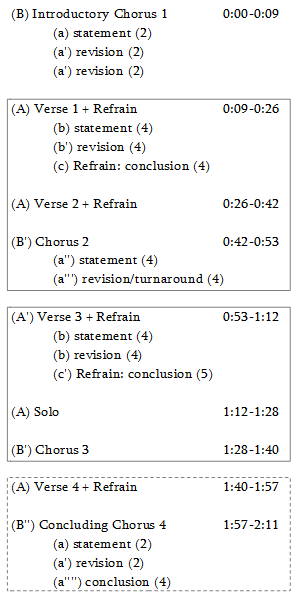 Sooooo, The Beatles' use of choruses is widely varied and at times convoluted. And this is complexity is compounded by the fact that so many songs use choruses in multiple ways within the same song. Tomorrow is the first of four double bookings over the next week.
Monday, 17 October 2016, 9:30-10:30 a.m. Beverly Public Library, 32 Essex St, Beverly, MA Shadow Ball: A History of The Negro Leagues When Jackie Robinson broke the color barrier in Major League Baseball on 15 April 1947, it marked one of the sport's greatest historical moments. But it also served as the beginning of the end for the Negro Leagues. This 60-minute multimedia presentation will observe and discuss the rise and fall of Negro League baseball. Monday, 17 October 2016, 7:00-8:00 p.m. Topsfield Town Library, 1 S Common St, Topsfield, MA The Beatles: Band of the Sixties Explore the music of The Beatles in this 60-minute multimedia presentation (part history and part musical analysis) spanning the full 1960's: beginning with the band's seminal visits to Hamburg, continuing through Beatlemania, and concluding with Abbey Road. The program will be supplemented with audio clips of music and excerpts from interviews with the band members. Last month at Beatles at the Ridge, Ivor Davis, author of The Beatles And Me On Tour, observed my musical notation drawings and suggested I also sell the cover photo from my book From the Shadow of JFK: The Rise of Beatlemania in America. The photo layers a shot of Kennedy with The Beatles in the background, as if emerging from JFK's shadow. While I'm much more of a musical artist than a visual one, I'm quite proud of what I was able to do with this picture. It took many hours of work and lots of trial and error to get the right alignment, coloration, and contrast. Perhaps some day I'll blog of the various steps behind creating the image, but not today. Anyway, taking Ivor's advice, I printed and framed the picture, and added it to my sales table. 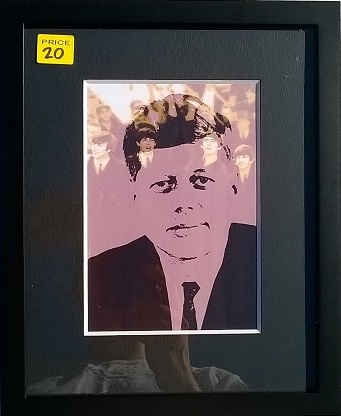 Ivor, next time I see you, I'll give you a complementary framed image as a thank-you for making the suggestion. Along with "Darth Yoko" that Kennedy/Beatles image will be available for purchase after all my presentations, but it's especially appropriate for tomorrow's topic.
Sunday, 16 October 2016, 2:00 p.m. Norwell Public Library, 64 South St, Norwell, MA From the Shadow of JFK: The Rise of Beatlemania in America Many Beatles authors have cited John F. Kennedy's assassination on 22 November 1963 as a cause of the Beatles' sudden popularity in the United States in early 1964. Their logic: Kennedy's assassination made America sad, then the Beatles made America happy again. But this commonly accepted answer is overly simplistic. The real answer is that Kennedy's life and death inadvertently primed the nation for the Beatles' arrival and success. This 60-minute program will explain how and why. When not studying The Beatles' music (a rare occasion), I'm likely to be studying John Williams' music. His film scores are just as iconic as The Beatles' albums, and few of his scores are better than those he wrote for the 7 Star Wars movies. Most of my presentations are about The Beatles, and I've created several Beatles-related drawings using musical notation symbols. 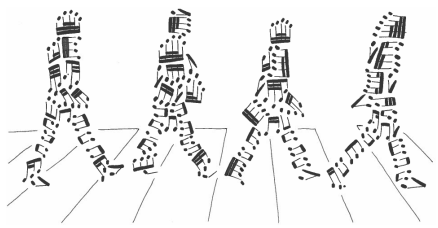 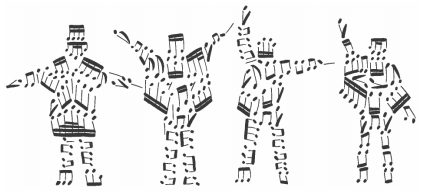 But since I also do presentations on the music of Star Wars, I recently applied the same idea to Darth Vader. 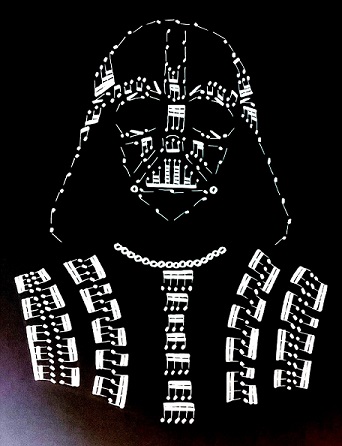 I typically set up the drawings for sale at each of my presentations, and it admittedly looks a little incongruous to have a ton of Beatles-related items, and then a drawing of Vader. But one man at my program in Milford, MA the other day found a connection. "I see you have the Beatles over here," he observed, pointing to the Abbey Road and Help! drawings, "and I see you have Yoko over there," this time pointing to Vader!
"Darth Yoko" will be available for purchase tomorrow after my Star Wars presentation at the Fairfield, CT library. Saturday, 15 October 2016, 2:00-3:00 p.m. Fairfield Public Library, 1080 Old Post Rd, Fairfield, CT The Music of Star Wars: A Celebration of John Williams' Film Scores Often called a “space opera”, one aspect of the Star Wars films that helped make them such a pop culture phenomenon was composer John Williams' ultra-romantic orchestral score. This 60-minute multimedia presentation will showcase the music of all seven movies, citing historical precedents and comparing musical influences with the twofold purpose of (1) illustrating how the music developed, and (2) enlightening listening and furthering enjoyment of the music. When planning lecture tours, I have to be careful that I'm in any given location at an appropriate time. For example, Arizona temperatures surpass triple digits in the summer, so I made sure to visit in March. (It was only 95 when I arrived!) Hurricane season in Florida peaks from August through October, which is why I visited the Sunshine State in February in 2016, and why I will visit in November 2017. And tornado season in the Great Plains occurs twice per year: from May through June, and again in November. That's why I was in Kansas, Missouri, and Arkansas last month. Wisconsin's winters are worst in February, thus I booked Dairy State speaking engagements for May, August, and November of this year, and June of last year. And New England, famous for its dazzling autumnal colors, is an ideal place to visit in October. I'm reminded of that fact every day as I drive across the Northeast - especially Vermont last week. When driving, I obviously can't take photos of the foliage. But the other day, while jogging in Randolph, MA, I took several shots. 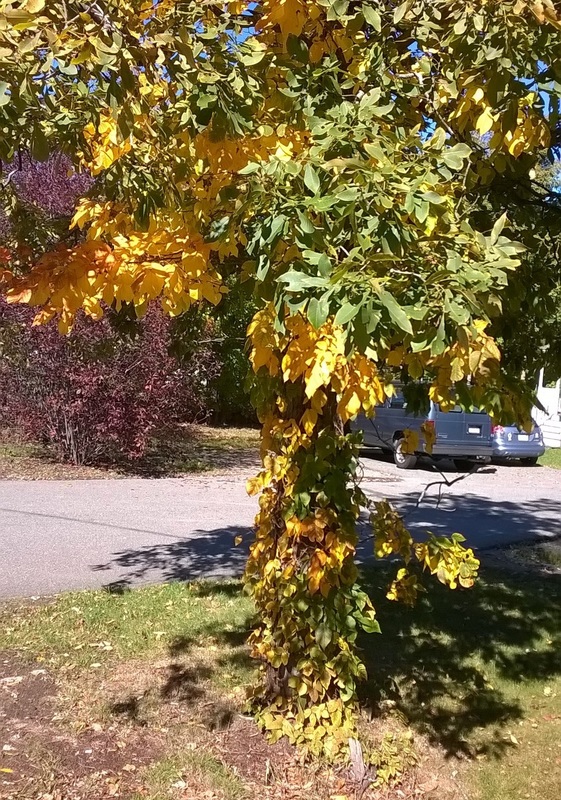   This tree in particular caught my attention. 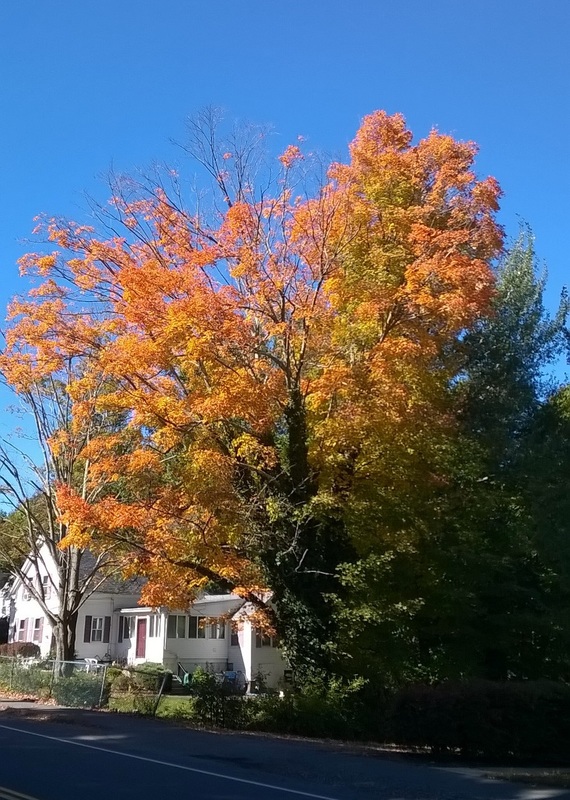 Especially how those orange leaves vibrantly contrast the brilliant blue sky. I'm already looking forward to returning to New England in October 2017. In the meantime, I'll continue enjoying the vibrant present.
Friday, 14 October 2016, 6:30-7:30 p.m. Charlton Public Library, 40 Main St, Charlton, MA The Beatles: Band of the Sixties Explore the music of The Beatles in this 60-minute multimedia presentation (part history and part musical analysis) spanning the full 1960's: beginning with the band's seminal visits to Hamburg, continuing through Beatlemania, and concluding with Abbey Road. The program will be supplemented with audio clips of music and excerpts from interviews with the band members. On Monday I blogged about SRDC form in Beatles songs, concluding that 40 of the band's tracks "use a clear SRDC phrase structure", and that other tracks exist that are more "complicated and ambiguous" in their use of that form. Then yesterday I blogged about ambiguity in 'The Fool On The Hill', concluding, "Just as there are two ways of interpreting the character and harmony, so too there are two ways of interpreting the structure." Those two previous blogs were designed to set up this third post because 'Fool' employs a rather complicated version of SRDC form that is correlated with the interpretation of its formal structure. If we interpret the song as having a refrain (and not a chorus), then each of the five "verse + refrain" iterations could be seen as one giant SRDC: S: Day after day, alone on a hill R: The man with the foolish grin is keeping perfectly still D: But nobody wants to know him. They can see that he's just a fool. And he never gives an answer. C: But the fool on the hill sees the sun going down and the eyes in his head see the world spinning round. The S and R phrases are textbook examples (in this case, the R is an ascending melodic sequence of S), but both the D and C phrases can both be broken into sub-phrases, each a single measure in duration. D sub-phrases: S: But nobody wants to know him D: They can see that he's just a fool. R: And he never gives an answer. C sub-phrases: I*: But the fool on the hill S: sees the sun going down R: and the eyes in his head R: see the world spinning round. [instrumental transition] * = I stands for introduction (an introductory sub-phrase) This might be thought of a "compound SRDC" form since one or more (in this case two) of the four SRDC phrases is comprised of multiple smaller parts. On the other hand, if we interpret 'Fool' as using a chorus (and not a refrain), then the same "compound SRDC" analysis applies, but now it's spread across multiple Formal Level sections - in this case a verse and chorus. SRDC form was devised to illustrate phrases within a single section, but if we expand the notion and start applying the same concept to larger, multiple-section structural modules, then we open up an entirely new realm of analytic possibilities because now other songs can be classified under the same category. For example, observe 'Revolution 1': Verse 1 0:16-1:02 (a) statement (6½) (a) restatement (6½) (b) departure (5½) Chorus 1 1:02-1:22 (c) statement (2) (c) restatement (2) (c) restatement (2) tag (2) The verse clearly contains the first three phrases of SRDC form, and the chorus could be thought of as a compound conclusion. Thus, the combination of verse + chorus yields a compound SRDC. And The Beatles would use comparable verse + chorus compound SRDC structures in 17 songs (many of which, like 'Fool On The Hill', are dependent on interpretation, or take minor liberties with the details):
In addition, a few Beatles tracks implement a pre-chorus to connect the verse and chorus, in which those pre-choruses function as a compound departure phrase. Example: 'All Together Now'. Verse 2 0:20-0:31 (a) statement (4) (a') revision (4) Pre-Chorus 0:31-0:43 (b) statement (2) (b') revision (2) (b) restatement (2) (b'') revision/transition (4) Chorus 0:43-0:53 (c) statement (2) (c) restatement (2) (c') revision (2) (c) restatement (2) The verse provides the statement and restatement, then the pre-chorus functions as a compound departure phrase, and the chorus as a compound conclusion. And this SRDC form stretched over three sections (verse, pre-chorus, and chorus) is found in two more Beatles songs:
Finally, I must give credit where credit is due. This principle of stretching SRDC form over multiple sections is not original. It's the primary tenet of Jay Summach's excellent article "The Structure, Function, and Genesis of the Prechorus", published by The Society for Music Theory (Volume 17, Number 3, October 2011). What I've done is applied Summach's concept specifically to Beatles music. Meanwhile, the tour continues with another round of "Band of the Sixties" tomorrow:
Thursday, 13 October 2016, 7:00-8:00 p.m. Westborough Public Library, 55 West Main St, Westborough, MA The Beatles: Band of the Sixties Explore the music of The Beatles in this 60-minute multimedia presentation (part history and part musical analysis) spanning the full 1960's: beginning with the band's seminal visits to Hamburg, continuing through Beatlemania, and concluding with Abbey Road. The program will be supplemented with audio clips of music and excerpts from interviews with the band members. Paul McCartney's haunting 'The Fool On The Hill' is fundamentally rooted in ambiguity. He cited the notion of the idiot/savant as the inspiration for the song - you're never sure if the person is a genius or an imbecile. And that ambiguous character fueled equally ambiguous music. As I document in this BEATLES MINUTE, the song's harmony is uncertain. Part of the song is in D major, while part of the song is in D minor. Just as there are two ways of interpreting the character (brilliant or stupid), so too there are two ways of interpreting the harmony (major or minor). Similarly, the song's structure is unclear: Is the section of the song featuring the title lyrics a refrain or chorus? In the BEATLES MINUTE above, I chose chorus. This interpretation is supported by the shifts in harmony (Paul looooves reinforcing structure with harmony), and results in the following structural analysis: 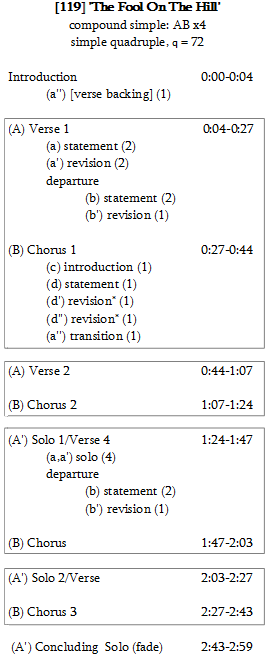 But it would be equally accurate to instead chose refrain. This interpretation is supported by its brevity. At only five measures in length, it would be among the shortest choruses in The Beatles' catalog (8-,12-, and 16-measure durations being more common). Additionally, choruses are so-called because they typically feature a "thicker texture" (Walter Everett's wording - not mine), often achieved through multiple voices - hence the term "chorus". In 'Fool', there is a slight thickening of the texture, though less than is customary, and Paul's vocals are double-tracked but it's still only Paul singing. Such interpretation would yield the following structural analysis: 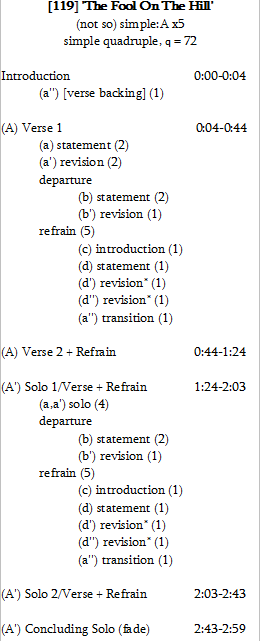 Neither is "right" or "wrong" - they're simply two different but equally valid interpretations. Just as there are two ways of interpreting the character and harmony, so too there are two ways of interpreting the structure. I make my Clinton, MA debut tomorrow.
Wednesday, 12 October 2016, 6:30-7:30 p.m. Bigelow Free Public Library, 54 Walnut St, Clinton, MA The Beatles: Band of the Sixties Explore the music of The Beatles in this 60-minute multimedia presentation (part history and part musical analysis) spanning the full 1960's: beginning with the band's seminal visits to Hamburg, continuing through Beatlemania, and concluding with Abbey Road. The program will be supplemented with audio clips of music and excerpts from interviews with the band members. I saw Cha-Chi Loprete, Boston-area radio personality and Beatles enthusiast, posted a tweet advertising tomorrow's program. I hope that means he's planning to attend, and that I'll get to meet him afterwards! The brilliant pop music scholar Walter Everett is credited with coining the term "SRDC form". It refers to a section (usually a verse but occasionally a chorus or bridge) that can be parsed into four phrases, the first of which is an expository statement (S), the second a restatement or revision of that initial statement (R), the third a departure from what has already been heard (D), and the fourth a conclusion (C). The Beatles used SRDC form frequently, and a textbook example can be found in 'I'm Looking Through You'. S: "I'm looking through you. Where did you go?" R: "I thought I knew you. What did I know?" D: "You don't look different but you have changed." C: "I'm looking through you. You're not the same." In this case, the alphabetic labeling of these phrases would be "aaba" - the first, second, and fourth phrases (S, R, and C) are all related and thus labeled "a", but the third phrase (D) is different and thus labeled "b". S (a): "I'm looking through you. Where did you go?" R (a): "I thought I knew you. What did I know?" D (b): "You don't look different but you have changed." C (a): "I'm looking through you. You're not the same." Ten additional Beatles songs use this SRDC/aaba form:
Similarly, some songs maintain the SRDC structure but base the conclusion on the music of the departure, resulting in an alphabetic label of aabb. 'I Will' is a good example. S (a): "Who knows how long I've loved you" R (a): "You know I love you still" D (b): "Will I wait a lonely lifetime?" C (b): "If you want me to I will" Six additional Beatles songs use this SRDC/aabb form:
Most common, however, is to leave the conclusion musically independent from the statements or departure. This results in an aabc structure, as found in 'Please Please Me'. S (a): "Last night I said these words to my girl" R (a): "I know you never even try girl" D (b): "Come on, come on, come on, come on" C (c): "Please please me like I please you" This SRDC/aabc form is found in an additional 23 Beatles tracks:
In total, The Beatles use a clear SRDC phrase structure in 42 tracks (19.9% of their 211-song output). From there, however, things get complicated and ambiguous. But that will be the topic for a future blog. Tomorrow begins the busiest stretch of my career so far: 23 speaking engagements in the next 19 days.
Tuesday, 11 October 2016, 6:30-7:30 p.m. Bridgewater Public Library, 15 South St, Bridgewater, MA The Beatles: Band of the Sixties Explore the music of The Beatles in this 60-minute multimedia presentation (part history and part musical analysis) spanning the full 1960's: beginning with the band's seminal visits to Hamburg, continuing through Beatlemania, and concluding with Abbey Road. The program will be supplemented with audio clips of music and excerpts from interviews with the band members. 81 (38.4%) of The Beatles' 211 songs employ a fade. If you really want the nitty-gritty complete song-by-song list, here 'tis: 
The majority of these 81 songs employ the fade in a traditional way: At the end of the track, the music gradually decreases in volume until no sound remains. But a few buck the trend and thus warrant individual consideration. 'Strawberry Fields Forever' incorporates not one but two fade outs: the first during the Coda 1 (around 3:30), then again during Coda 2 (around 4:00). Similarly, 'Helter Skelter' fades to nothing around 3:30 only to fade back in around 3:45 before Ringo's "blisters on my fingers" concludes the track. In 'Good Morning Good Morning', the "music proper" fades to nothing around 2:30, but the animal stampede continues at full volume. Likewise, in 'You Never Give Me Your Money', the "music proper" fades to nothing around 3:50, but the sound of crickets and a wind chime continue with volume undiminished. Finally, a few tracks use fade-ins. Excluding the "fade out and then back in" examples discussed above (in 'Strawberry' and 'Helter Skelter'), only four tracks employ a fade in:
The first leg of October's tour concludes tomorrow with a geographically appropriate location for a talk on JFK: Cape Cod, MA, where he lived.
Saturday, 8 October 2016, 2:00-3:00 p.m. Cotuit Library, 871 Main St, Cotuit, MA From the Shadow of JFK: The Rise of Beatlemania in America Many Beatles authors and scholars have cited John F. Kennedy's assassination on 22 November 1963 as a cause of the Beatles' sudden popularity in the United States in early 1964. Their logic: Kennedy's assassination made America sad, then the Beatles made America happy again. But this commonly accepted answer is overly simplistic. The real answer is that Kennedy's life and death inadvertently primed the nation for the Beatles' arrival and success. This 60-minute program will explain how and why. Everybody knows that brevity was a trademark of the early Beatles. It's also quite obvious that the band explored progressively longer song durations as they evolved. What's less obvious is the empirical data to prove those notions. So, I've created a spreadsheet containing all 211 officially recorded and released tracks and their lengths in seconds.
The Beatles' career can be broken down into stylistic periods. First, juvenilia, from 1962 to mid-1964 ('Love Me Do' through 'When I Get Home'); second, artistic adolescence, from mid-1964 through 1965 ('Baby's In Black' through 'Girl'); third, psychedelia, from 1966 through 1967 ('Tomorrow Never Knows' through 'Hello Goodbye'); and fourth, retrospective, from 1968-1970 ('The Inner Light' through 'I Me Mine'). Averaging song durations within these stylistic periods conclusively illustrates The Beatles' quest for progressively larger structures and longer durations.
Yesterday I spoke in the northwest corner of New England (Rutland, VT); tomorrow I speak in the southeast corner of New England (Hyannis, MA).
Friday, 7 October 2016, 7:00-8:00 p.m. Hyannis Public Library, 401 Main St, Hyannis, MA The Beatles: Band of the Sixties Explore the music of The Beatles in this 60-minute multimedia presentation (part history and part musical analysis) spanning the full 1960's: beginning with the band's seminal visits to Hamburg, continuing through Beatlemania, and concluding with Abbey Road. The program will be supplemented with audio clips of music and excerpts from interviews with the band members. |
Beatles BlogThis blog is a workshop for developing my analyses of The Beatles' music. Categories
All
Archives
May 2019
|
||||||||

 RSS Feed
